
11 projects · Java · TypeScript · Luau · GLSL

Engines, games and simulations, built layer by layer.

Eleven projects by a high-school student in France, with real screenshots and figures measured from the code.

strates 11 projects

Artificial life

OpenAvida Lab

Open source
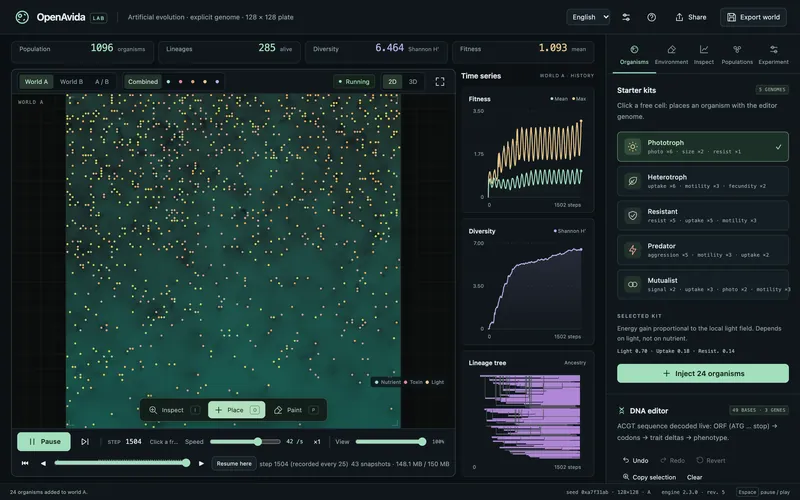
The lab interface: a plate of evolving organisms, fitness and diversity charts and the starter kits.

An artificial-evolution lab that runs in the browser. Each organism has an editable genome that decodes to a readable phenotype. Organisms compete on a plate with nutrient, toxin, temperature and light fields, and the lab tracks lineages live.

test cases
326
lines of TypeScript
30.9k
commits
77
  • TypeScript
  • Vite
  • Vitest

Stack

Built with

  • Java3 projects
  • Fabric2 projects
  • Vulkan1 project
  • GLSL3 projects
  • Three.js2 projects
  • JavaScript4 projects
  • TypeScript2 projects
  • React1 project
  • Electron1 project
  • Luau2 projects
  • Rojo1 project
  • Blender2 projects

About

How I work

I am a high-school student in France. I build engines, games and simulations. This year I am working on a light-to-sound instrument for the French Physics Olympiad.

I design, direct and review; AI coding agents help me write the code.

  1. 01

    Check against a reference

    Dijkstra is tested against an independent Bellman-Ford oracle, the Python in lessons against real Python, the Vulkan port against OpenGL screenshots.

  2. 02

    Simulate the real thing

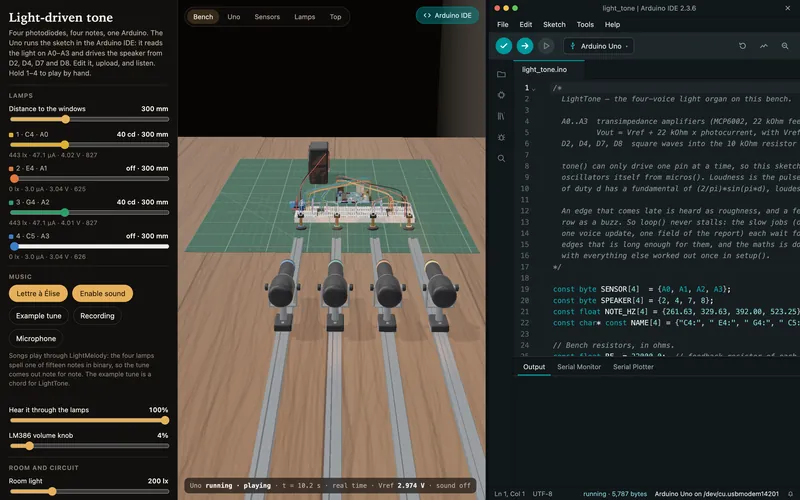
    The light bench models filament warm-up time, photodiode spectra and the AVR clock. The voxel renderer computes its sky from Rayleigh and Mie scattering.

  3. 03

    Plan, then build in waves

    A large project starts with an architecture document, interface contracts and acceptance tests. AI agents then write the code in parallel waves, and I review each wave before the next one.

FAQ

Questions

Where is the code?

OpenAvida Lab and Light-driven tone are public on GitHub. The other nine repositories are private for now. To see one, open an issue on either public repository.

Do you use AI?

Yes. I write the plans, the architecture and the acceptance tests, and I review every change. AI coding agents write much of the code, often several at once.

What is the Physics Olympiad project?

An instrument that turns light into sound: lamps slide on motorised rails above four photodiodes, and an Arduino turns their photocurrents into notes. Light-driven tone simulates the whole bench so the firmware can be tested before the hardware exists.

Can I try something right now?

Sneaky Hatch is live on Roblox. OpenAvida Lab and Light-driven tone run in the browser from their repositories with npm run dev.

What comes next?

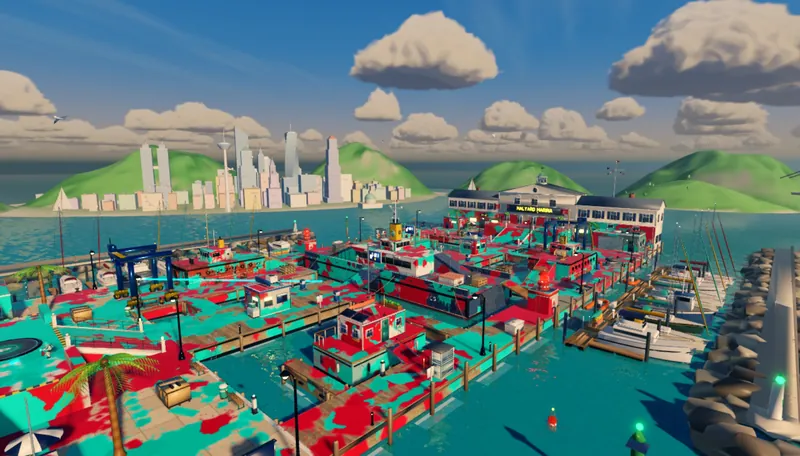
Finishing Inkrush's first playable milestone, a 4v4 match on the Tidewater map. After that, getting Vulkan Shaders to run on Windows and Linux as well as the Mac.

Start with the evolution lab.

OpenAvida Lab is open source and runs in the browser.

git clone https://github.com/Baklawaa/openavida-lab
Visit GitHub